The setup
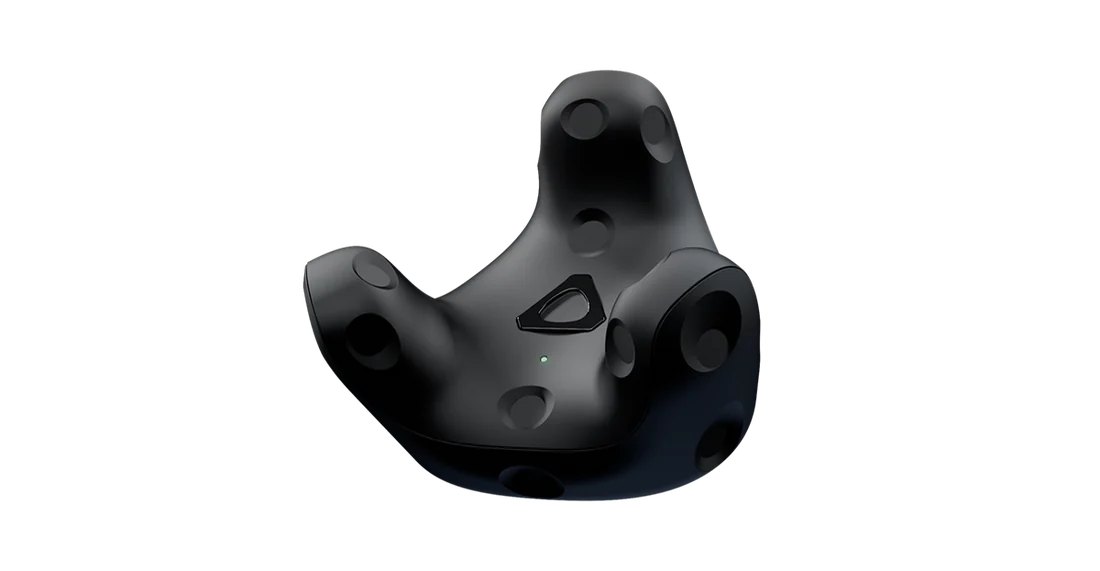
The VIVE Tracker (3.0) is HTC's current general-purpose SteamVR tracking puck, sold through its own VIVE storefront as an accessory rather than a headset. HTC's own product page lists it as a strap-mountable sensor that reports position and orientation to any SteamVR-compatible headset, and pairs it in the same catalog with the SteamVR Base Station 2.0, the emitter hardware a tracker needs to establish a tracking volume. This is documentation for hardware, not a single dated release: the page describes what ships today and how it compares to HTC's own earlier tracker, not a specific announcement.
What the documents show
HTC's product page states the tracker offers 'Support for SteamVR™ BS1.0 and BS2.0,' meaning it works with both the older and current generation of base stations rather than forcing an upgrade. Listed specifications give a weight of 75g ('15% lighter than VIVE Tracker (2018)'), dimensions of 70.9 x 79.0 x 44.1mm ('33% smaller'), a 240-degree field of view, and 7.5 hours of battery life ('Up to 75% longer'). Every comparison is against HTC's own prior model, not a competitor: a generational upgrade claim, not an independent accuracy test. The base station listing confirms the 2.0 emitter is sold separately at $229, the second piece of hardware a full-body rig needs.
The craft
For full-body capture, HTC's own page recommends '3+ trackers,' typically strapped to the hips and both feet, so a game engine or avatar tool can infer the rest of the skeleton with inverse kinematics. The page itself features a VTuber customer, Virtual Girl Nem, describing the goal in practical terms: syncing body motion so 'your avatar will feel as if it is a part of your own body.' That framing matches how most VTuber setup guides use this hardware: three trackers plus a headset for head tracking is the common minimum, with additional trackers for elbows or a chest sensor added as budget and rig complexity allow.
Keeping the creator in control
Because the tracker is a generic SteamVR device rather than a proprietary VTuber product, the performance data it generates flows through whatever software the creator chooses to pair it with, and stays on hardware the creator owns outright. That is an editorial point beyond what HTC's page states, but it follows from the documented fact that the tracker is base-station- and software-agnostic: a creator is not locked into a single avatar tool by buying it. The trade-off is cost and setup complexity, since base stations, trackers, and straps are bought and mounted separately.
- How many trackers does a given rig actually need before added ones stop improving the result?
- Is the tracked space large enough for the base stations' line of sight, and what happens at its edges?
- Does the avatar software receiving this tracking data store or transmit motion capture beyond the local session?
Read plainly, HTC's own listing describes a compatibility-first update to a tool many VTubers already own, not a new tracking method, and that continuity is the useful fact for anyone budgeting a full-body setup today.
Sources & reading trail
States base-station compatibility, weight/size/battery comparisons to the 2018 tracker, and the 3+ tracker recommendation.
Source published: Not established · Retrieved: 16 September 2026
Confirms the current base station generation is sold as a separate $229 accessory.
Source published: Not established · Retrieved: 16 September 2026
Documentation, agency filings and platform records establish the entry; the craft reading is VTubing editorial analysis. This retrospective draft does not imply the site published on the event date.