The setup
Warudo, built by Hakuya Labs, is 3D VTubing software built around a visual programming system rather than the layered rigging Live2D tools use, documented at docs.warudo.app, current as retrieved on 16 September 2026. Where a Live2D rigger builds deformers inside Cubism Editor, a Warudo user builds behavior through 'blueprints,' and gets 3D props by importing assets or through Steam Workshop, which Warudo's own Steam page lists as supported. This entry documents that system and its licensing, not the original release, covered separately.
What the documents show
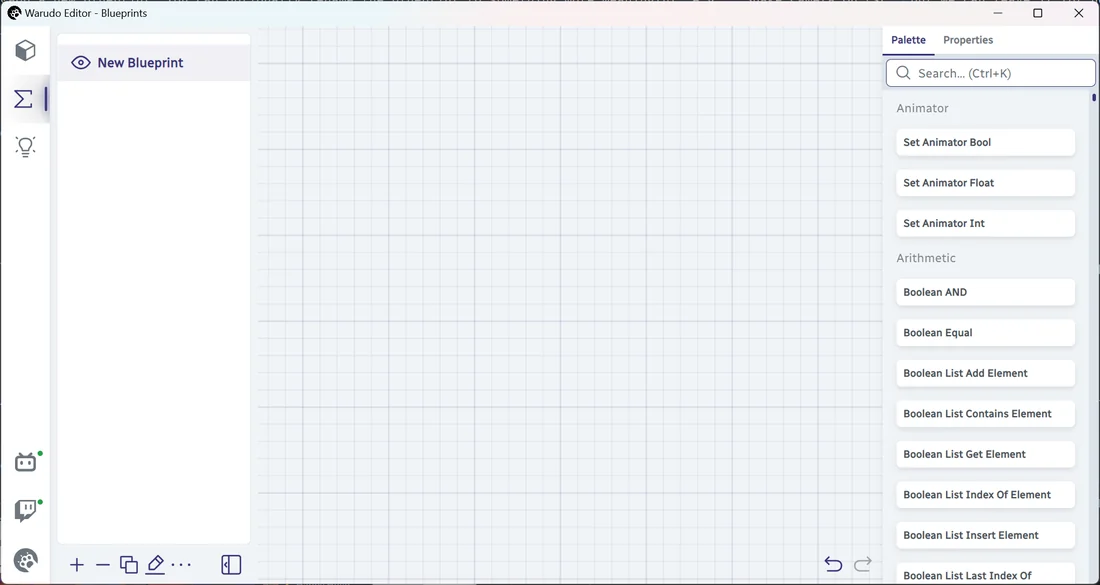
The Warudo Handbook documents blueprints as node graphs joined by two connection types: 'flow connections determine the order in which the nodes are triggered, from left to right,' while 'data connections are responsible for passing data between nodes,' shown as green flow ports and black data ports. A flow input accepts multiple flow connections but a flow output feeds only one, 'otherwise it would be unclear which node should be triggered first,' and the same applies to data. A companion Assets page documents characters, props and cameras as objects blueprints reference, exportable to and importable from JSON between scenes. Separately, Warudo's Steam listing requires a distinct EULA and defines a 'personal use' license: free use requires 'the copyrights of your VTubing persona are exclusively yours' and no contract obligating fixed weekly streaming outside a major platform's own terms, else the developer must be contacted for a commercial license.
The craft
Customizing Warudo is closer to light visual scripting than illustration-based rigging: shaking a camera on a keystroke means dragging an 'On Keystroke Pressed' node and a 'Shake Camera' node into the editor and connecting them, then wiring a 'Get Main Camera' node's output into the Shake Camera node so the effect follows whichever camera is active rather than a fixed dropdown choice. Because assets and blueprints both export to JSON, a creator can build a lighting rig once and reuse it across scenes, rather than rebuilding it each time.
Keeping the creator in control
The personal-use license is a meaningful condition, not boilerplate: it ties free use to the creator holding their persona's copyright and accounts outright, mattering for a performer weighing an agency contract against independence, since fixed-hour agency streaming falls outside the free tier as described. Workshop integration also means scene assets may come from third parties publishing through Steam, so an asset's own permissions should be checked before monetized use, separate from Warudo's EULA. This is editorial, beyond what either document states directly.
- Does this creator's current streaming arrangement, including any agency contract, still qualify under Warudo's stated personal-use definition?
- Have Workshop-sourced assets in this scene been checked for their own creator's usage terms, separate from the Warudo EULA?
- Is a given piece of scene behavior built as a reusable, exportable blueprint, or one-off settings that will need rebuilding later?
Warudo's documentation describes a different rigging paradigm from Live2D's layered pipeline, built on node graphs and importable 3D assets, but its free tier is conditioned on a stated definition of personal use a creator moving between independent and agency work should reread rather than assume still applies.
Sources & reading trail
Documents the node-based blueprint system: flow connections determine trigger order, data connections pass typed values between nodes, and each output can feed only one connection of its kind.
Source published: Not established · Retrieved: 16 September 2026
Documents assets such as characters, props and cameras as the scene components blueprints reference, with import/export via JSON for moving assets between scenes.
Source published: Not established · Retrieved: 16 September 2026
States Warudo integrates Steam Workshop, requires agreement to a separate Warudo EULA, and defines a free personal-use license distinct from commercial use requiring direct contact with the developer.
Source published: Not established · Retrieved: 16 September 2026
Documentation, agency filings and platform records establish the entry; the craft reading is VTubing editorial analysis. This retrospective draft does not imply the site published on the event date.