
The setup
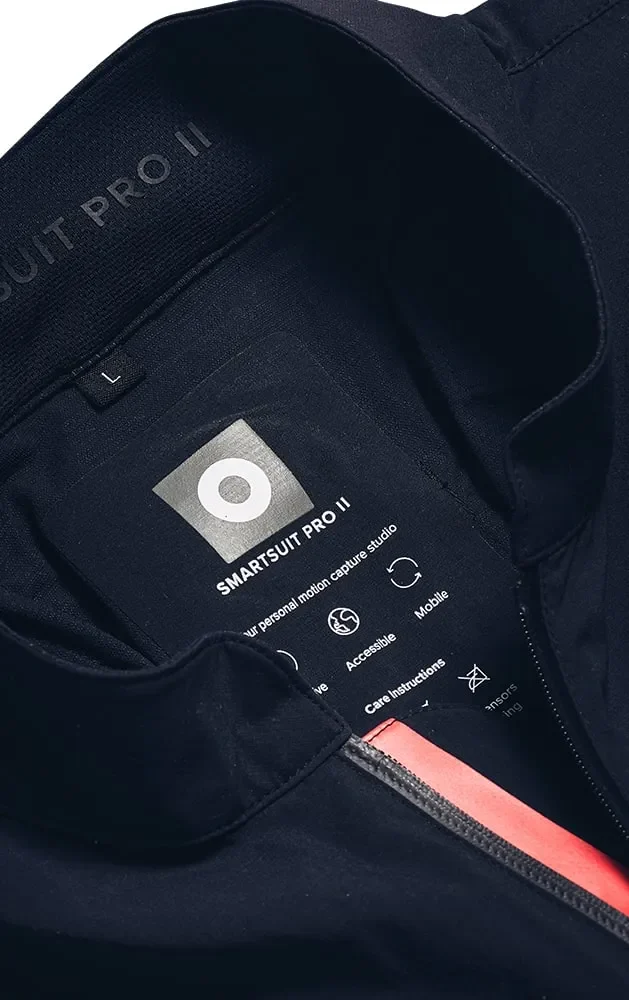
Rokoko's current full-body suit for inertial motion capture is documented on the company's own site as the Smartsuit Pro II, the second generation of the product this entry's topic names. Rokoko's product page markets it to 'Disney, Netflix, EA and more than 25,000 indie creators worldwide,' alongside VTubers and independent studios, and pairs the hardware with Rokoko Studio, the company's companion capture and export application. This is a living-document entry: it describes the suit as currently sold and documented, not a dated release.
What the documents show
Rokoko's product page states the suit uses 9-degrees-of-freedom sensors with '3D orientation accuracy: ± 1 deg' at a '200 fps' sensor frame rate, but does not state an exact sensor count. Rokoko's own support documentation supplies the figure the marketing page omits: the suit is 'a textile suit embedded with 19 wired IMU sensors (17 sensors if Glove-Ready edition), a Hub,' plus a headband sensor. That support article also documents the unboxing and requirements: a Wi-Fi router, a computer meeting Rokoko's stated system requirements, and a USB power bank rated for at least 2A output (3A for the glove-ready edition).
The craft
The product page states exported animation can target 'FBX, BVH, or CSV at your preferred frame rate,' mapped onto 'industry-standard skeletons' including HumanIK, Mixamo, Unreal Engine, or a custom rig - the step that actually gets a captured performance onto a VTuber's model rather than leaving it as raw sensor data. Rokoko's support documentation frames setup as a sequence: configure the suit's Wi-Fi in Rokoko Studio before first wearing it, place the headband sensor, then check that body-segment sensors sit parallel to the wearer's limbs before recording, since misaligned sensors are a documented source of drift in inertial systems generally.
Keeping the creator in control
Because the suit exports to open formats like FBX and BVH rather than a closed pipeline, a performance captured on Rokoko's hardware is not locked to Rokoko's own software once exported - editorially, a meaningful ownership point for a creator whose model lives in a different engine. The suit's wireless, battery-powered design (documented power-bank requirements above) also means a performance is not tethered to a fixed desk position, which matters for creators choreographing full-body segments rather than seated streams.
- Does the suit's stated 19-sensor (or 17-sensor, glove-ready) coverage match the joints the target rig actually needs animated?
- Is the required Wi-Fi router on Rokoko's own recommended list, given the company documents specific compatibility issues?
- Which exported format, FBX or BVH, does the destination engine handle with the least retargeting work?
Reading the marketing page and the support article together is the useful move here: one states the accuracy claims and price-facing use cases, the other supplies the sensor count and setup steps a creator actually needs before recording.
Sources & reading trail
States sensor accuracy and frame rate, export formats (FBX, BVH, CSV) and supported skeleton rigs, and stated customers.
Source published: Not established · Retrieved: 16 September 2026
States the exact sensor count (19, or 17 for the glove-ready edition), power and Wi-Fi requirements, and setup sequence.
Source published: Not established · Retrieved: 16 September 2026
Documentation, agency filings and platform records establish the entry; the craft reading is VTubing editorial analysis. This retrospective draft does not imply the site published on the event date.