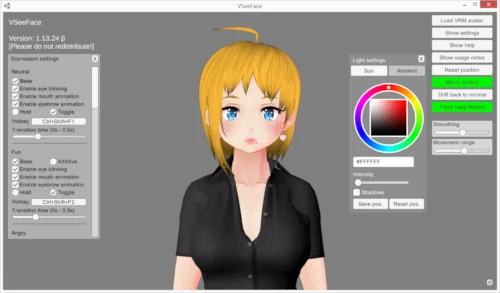
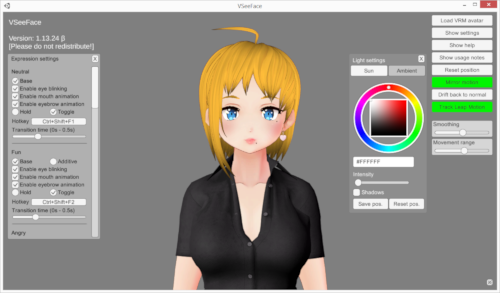
The setup
'Perfect sync' is the term the free, open-source app VSeeFace uses for full ARKit facial capture, and VTube Studio, made by DenchiSoft, is one of the iPhone-tracking sources VSeeFace names for that data. This entry treats both projects' own documentation as primary sources, and notes VTube Studio's wiki does not use the phrase 'perfect sync' itself; it documents the underlying feed under plainer names, so this entry keeps the two sources' claims separate rather than presenting community terminology as VTube Studio's own.
What the documents show
VSeeFace's own site states 'perfect sync is supported through iFacialMocap / FaceMotion3D / VTube Studio / MeowFace,' and its troubleshooting section is explicit: 'when using perfect sync, the 52 ARKit blend shape clips need to be present,' and 'all 52 blend shape clips must be present on the model' even if empty, a naming and completeness requirement, not a tracking-quality claim. DenchiSoft's own developer repository, VTubeStudioBlendshapeUDPReceiverTest, documents what the iOS app can send: 'all 52 raw iOS blendshape values,' plus head and eye rotation, over UDP once a receiving app requests it, naming VSeeFace and the paid plugin VBridger as consumers. VTube Studio's own wiki page on sending data to VSeeFace confirms this streaming is 'included in iOS version of VTube Studio completely for free,' requiring '3rd Party PC Clients' enabled before any app can request it.
The craft
A rigger preparing a model for full facial tracking through VTube Studio's iPhone feed needs to build against the 52-name ARKit standard Apple defines, not a VTube-Studio-specific scheme, since the data transmitted is the same raw set any perfect-sync consumer expects. A 2D Live2D model, VTube Studio's primary format, maps a subset onto Cubism parameters inside the app; a 3D model driven through VSeeFace or VBridger needs the full 52-clip set on the mesh, even clips with no visible deformation, since VSeeFace requires all 52 regardless of use.
Keeping the creator in control
Because the same feed can be read by any receiving app once 3rd Party PC Clients is enabled, a performer decides how much captured facial data leaves VTube Studio, and where, by choosing which tool to point at that stream, not through a separate consent step. Comparing both projects' documentation shows the feature is free on VTube Studio's side but full 3D use depends on a paid plugin in one common workflow; a creator budgeting for full facial tracking should treat that cost as separate from VTube Studio's own price.
- Does the model actually carry all 52 ARKit blendshape clips VSeeFace's documentation requires, even ones staying at zero?
- Is '3rd Party PC Clients' enabled only while an intended receiving app is in use, to limit how long the stream is open?
- Which receiving application, free or paid, is consuming this feed, and what does its own documentation say it stores?
What gets called 'perfect sync' is really a shared data contract, the 52-blendshape ARKit standard, that VTube Studio documents feeding into other software rather than a feature it names itself, and knowing that boundary is what lets a creator judge whose terms actually govern their facial data.
Sources & reading trail
Defines perfect sync as receiving full ARKit blendshape tracking data, requiring all 52 blend shape clips on the avatar, and lists VTube Studio among the supported iPhone tracking sources.
Source published: Not established · Retrieved: 16 September 2026
Documents VTube Studio's iOS app sending all 52 raw iOS/ARKit blendshape values plus head and eye tracking data over UDP to third-party receivers such as VSeeFace and VBridger.
Source published: Not established · Retrieved: 16 September 2026
States this iPhone blendshape streaming feature is free in the VTube Studio iOS app and requires enabling 3rd Party PC Clients before use.
Source published: Not established · Retrieved: 16 September 2026
Documentation, agency filings and platform records establish the entry; the craft reading is VTubing editorial analysis. This retrospective draft does not imply the site published on the event date.