The setup
A raid sends a broadcaster's connected chat audience to another channel, usually at the end of a stream. Twitch's own Raids help article, as retrieved on 16 September 2026, and a 2 November 2017 blog post together document how the feature works and where it came from.
What the documents show
The 2017 post states Raids were originally invented by creators as an informal, manual practice, and that Twitch's own update added a simple /raid command, an automated countdown, automatic redirection and new moderation tools rather than inventing the underlying behavior. The current help article states any creator, regardless of Affiliate or Partner status, can start a raid, and describes a Raid Browser that suggests recipients filtered by category, follower relationships, viewer count and similar audience size. It states an incoming raid can be filtered by the raiding channel's viewer count and account age, that a channel can block all incoming raids for up to an hour with a dedicated control, and that raiders arriving from a raid see no pre-roll ads on the receiving channel. The article also states raided viewers can opt out during the pre-raid countdown rather than being redirected automatically without notice.
The craft
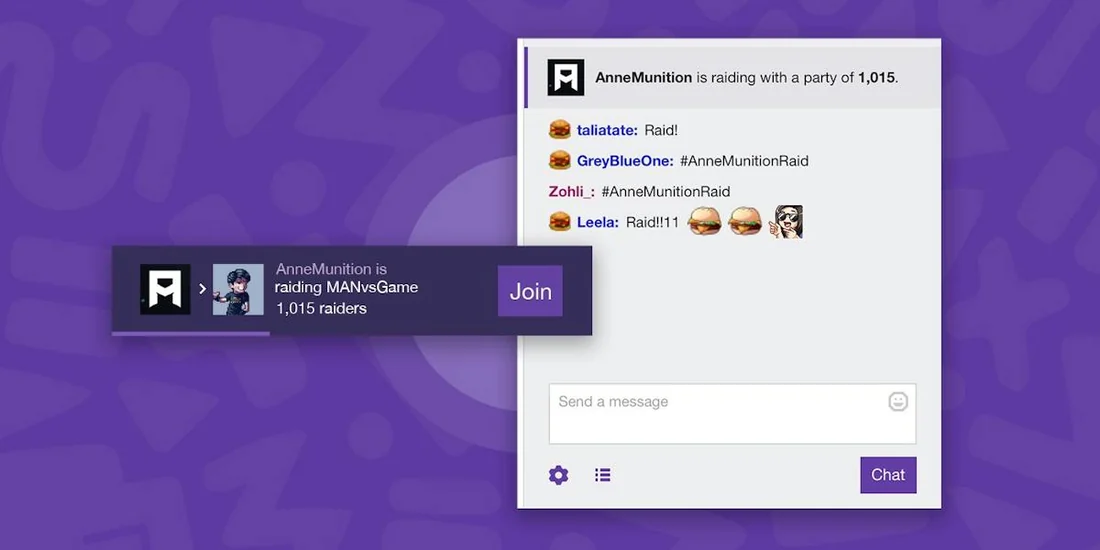
A raid works as a scheduled, public hand-off of attention at the natural end of a stream: the outgoing broadcaster gets a moment to thank their own audience and point them somewhere specific, and the receiving broadcaster gets a chat notification naming the raid and its size before the new viewers arrive. The Raid Browser's filters, such as similar size or same category, describe a tool built for finding peer-level collaborators, not only for large channels raiding small ones.
Keeping the creator in control
The incoming-raid settings, viewer-count floors and ceilings, account-age minimums, and the ability to block raids entirely for an hour, are the article's own description of how a broadcaster keeps a raid from becoming an unwanted or hostile arrival, distinct from choosing to raid someone else outward. That an opt-out window exists for raiding viewers, not just for the receiving channel, is a detail worth surfacing, since it shows the control the documents describe is not one-directional.
- Are this channel's incoming-raid filters set deliberately, or left at whatever the platform defaults to?
- Would the Raid Browser's similar-size or same-category filters surface better collaborators than manually chosen ones?
- Is the one-hour raid-blocking control known and ready to use before, not during, an unwanted event?
Read together, the two documents show Raids moving from an unofficial creator habit into a maintained, moderated feature, a path several Twitch community tools have followed.
Sources & reading trail
States how a raid is started, previewed and moderated, including incoming-raid viewer-count and account-age settings a channel owner can set.
Source published: Not established · Retrieved: 16 September 2026
Twitch's own announcement stating Raids began as an informal creator practice before Twitch formalized it with a slash command, countdown and moderation tools.
Source published: 2 November 2017 · Retrieved: 16 September 2026
Documentation, agency filings and platform records establish the entry; the craft reading is VTubing editorial analysis. This retrospective draft does not imply the site published on the event date.